Posts Tagged: dermatology
Pet Allergies: From Head Shakers to Bottom Scooters

When your allergic pet gnaws on her haunch or licks his feet incessantly, the habit might annoy you just as much as it does the pet. Some furry friends go their entire lives without suffering from allergies. But those of us who have had pets with allergies know the problem can take a big toll on quality of life.
Dr. Stephanie Bruner is a veterinary dermatologist at the University of Illinois College of Veterinary Medicine. She sees patients at the Veterinary Teaching Hospital and offers insights into what’s going on with all that scratching and shaking.
Dermatology Services at Medical District Vet Clinic
Since November 2025, Dr. Clarissa Souza, a boarded dermatologist from the University of Illinois Veterinary Teaching Hospital, has offered appointments on a part-time basis at the Medical District Veterinary Clinic in Chicago. She diagnoses and treats allergies, skin infections, ear diseases, hair loss, nail and nail bed diseases, itching/scratching/biting, and more.
Please call 312-226-2588 to schedule a dermtology appointment for your pet.
What Are Allergies?
“Allergies occur when the patient’s immune system experiences an over-the-top response to any of a wide variety of triggers,” Dr. Bruner explains. “Offending stimuli may range from fleas, foods, pollens, and mold spores to dust mites or even medications. The result is an adverse reaction somewhere in the body.”
Currently, science does not have an answer for why allergies occur in one individual but not another. However, we do know that certain breeds are more susceptible to allergies.
“Genetics plays a role,” Dr. Bruner says. “Various breeds of retrievers, spaniels, and terriers, to name a few, are at a higher risk of developing clinical signs associated with environmental allergens.”
Other factors besides genetics include geography, seasonal fluctuations in pollen counts, the animal’s indoor and outdoor habits, air quality, diet, and the health of the patient’s skin barriers.
“This exceedingly lengthy list explains, at least in part, why no two allergy patients can be treated the same way,” says Dr. Bruner. For this reason, veterinary dermatologists must take a tailored approach to treating each allergy patient.
Allergy Symptoms
In humans, allergies tend to manifest as itchy eyes, sneezing, or runny noses. They can appear as rashes or even result in inflammation and difficulty breathing. In dogs and cats, however, allergies trend toward a different list of symptoms entirely.
In dogs, symptoms include scratching, licking, and rubbing in areas such as the ears, face, feet, belly, and rear end.
“I refer to these as my ‘Big Five’ patients,” Dr. Bruner explains. “These are the head shakers, face rubbers, foot lickers, belly scratchers, and bottom scooters.” Other signs include ear or skin infections that just keep coming back, no matter how often you treat them.
Our feline friends are better at hiding symptoms, and therefore cat allergies tend to look more like excessive grooming. “Cat allergies can also become more obvious if itchy crusts develop on the skin or large areas of swelling arise, possibly resembling ulcers or growths,” says Dr. Bruner.
Identifying the Allergy Culprit
When diagnosing an animal with allergies, veterinarians start by determining what is not causing the reaction.
“First, allergies are diagnosed by ruling out other disorders that can mimic them, such as external parasites, fungal infections, or autoimmune disorders,” Dr. Bruner explains. “Then, the real work begins.”
Pets, like people, suffer from many different types of allergies, such as environmental allergies and food allergies. The first type of allergy to rule out is flea allergy dermatitis.
“Flea allergy dermatitis patients are not typically horribly infested with fleas, but a small number of fleas can cause big problems,” says Dr. Bruner. “Routine flea prevention, prescribed by a veterinarian, can be a real game changer.”
If fleas aren’t to blame, then doctors move on to environmental allergies. “In this case, the patient’s medical history can help answer this question. For example, a dog that only scratches and experiences ear infections in the summer is less likely to be reactive to foods.”
For those patients who do not have a seasonal aspect to their allergy symptoms, a diet trial is the next step. “A highly restricted diet trial, using a prescription-grade food under the guidance of a veterinarian, may be the next diagnostic test performed,” Dr. Bruner states.
During the diet trial, which lasts at least eight weeks, the pet cannot have any treats, table food, or dog food other than the special diet food prescribed. “If the patient does not improve by the end of the trial, environmental allergens are likely to be at fault.”
Finding Relief from Allergies
For those pets with food allergies, treatment means staying away from the foods that have been found to cause the reaction. For those with environmental allergies, treatments can range from medicated shampoos, sprays, lotions, and wipes to oral medications or injections.
Dr. Bruner adds, “Most patients will achieve their best outcomes when a veterinarian or veterinary dermatologist works with the whole family and puts together a highly personalized care plan that includes several of these treatment modalities to attack the problem from multiple angles.”
Unfortunately, no “cure” for pet allergies exists. Treatments are meant to ease symptoms so the patient can be more comfortable throughout the rest of their life. “My goal as a veterinary dermatologist is to develop a safe and effective care plan for every allergy sufferer. The plan should be sustainable—both in terms of time and financial investment—for their humans,” Dr. Bruner explains. “Perhaps the best thing that pet owners can do is be aware of the possible early signs of allergies—remember the Big Five!—and consult with a veterinarian before secondary ear and skin infections take the problem to the next level.”
’Tis the Season for Pet Allergies

Pets may be plagued with allergies at any time of the year, according to Dr. Jennifer Clegg, a veterinarian who is completing a residency in dermatology at the University of Illinois Veterinary Teaching Hospital in Urbana. If you suspect allergies are bugging your pet, Dr. Clegg recommends that you see your local veterinarian.
What are the signs that your pet may have an allergy?
“Licking and chewing paws or limbs, scratching ears, shaking the head or face, rubbing the body on rugs or carpets or furniture, and rubbing the hind end on rugs or carpets are all common signs of allergies,” says Dr. Clegg. “You may notice that the excessive licking or scratching has led to hair loss, or even that your pet is pulling out its hair, which happens mainly in cats.”
Dermatology Services at Medical District Vet Clinic
Since November 2025, Dr. Clarissa Souza, a boarded dermatologist from the University of Illinois Veterinary Teaching Hospital, has offered appointments on a part-time basis at the Medical District Veterinary Clinic in Chicago. She diagnoses and treats allergies, skin infections, ear diseases, hair loss, nail and nail bed diseases, itching/scratching/biting, and more.
Please call 312-226-2588 to schedule a dermtology appointment for your pet.
Narrowing the Diagnosis
Your veterinarian will eliminate the most common possible allergies first. Parasites that live outside the body, such as fleas and mites, frequently cause allergies in pets. A flea and tick preventive medication prescribed by your veterinarian should stop this problem. However, if this medication does not get rid of the itchiness, the next step is to consider whether your pet’s food is the cause.
“Some allergies arise when the pet develops hypersensitivity to the protein in their diet,” explains Dr. Clegg. “In these cases, we implement a diet trial, replacing the protein source in the diet with either a prescription hydrolyzed protein diet or a novel protein diet for 8 to 12 weeks.
“By the end of the diet trial, the pet should be symptom free if the protein was the culprit. If the previous diet is then restored and the symptoms return, a food allergy diagnosis is confirmed.”
A successful diet trial requires strict adherence by pet and client. No flavored medications, supplements, toothpastes, snacks, or other food should be given during the trial period.
“Even oral heartworm or flea and tick preventatives must be avoided and a topical product used instead while the pet is on the diet trial,” says Dr. Clegg.
If the diet trial doesn’t eliminate the allergy symptoms, then the pet probably has an environmental allergy.
Outdoor Vs. Indoor Allergens
Unfortunately, in most cases the source of an environmental allergy cannot be eliminated. After all, Dr. Clegg says, “You can’t remove all your trees from your yard or remove all your neighbor’s trees.”
In these cases, the pet’s symptoms must be managed instead. Outdoor allergens vary with the season, if you live in a part of the world that goes through seasonal changes.
Both dogs and cats suffer from springtime allergies, most commonly when trees begin to pollinate. (Although cats are mainly indoor, pollen from trees is in the air and can enter the home.)
In the summer, the main pollen comes from grasses. “Kentucky blue, timothy, orchard, and rye grasses commonly contribute to grass pollen allergies in the Midwest,” notes Dr. Clegg. “And in central Illinois, corn pollen presents a problem for allergic pets during harvest time.”
During fall, weed pollination and ragweed are the main sources of allergens. Additionally, mold spores tend to rise in the fall due to falling leaves and dying plants. Molds thrive on decomposing plant matter and their spores can float in the air.
“For some pets, wiping the paws clean after they come inside may help, but this alone will not be curative,” she says. “However, veterinarians have a variety of prescription medications at their disposal to help manage allergy symptoms. Treatment is tailored to the individual pet.”
Winter typically puts an end to outdoor environmental allergens, but mold spores may continue to be an issue. Indoor environmental allergens are a problem year-round. Veterinarians most commonly see allergies to dust or storage mites.
“Unfortunately, even if you vacuum your house every day and are the most immaculate housekeeper on earth, you will never entirely rid your house of dust mites,” says Dr. Clegg.
Parting Advice
So, what can you do for your itchy pet with an environmental allergy?
Dr. Clegg recommends keeping your pet on year-round flea and tick preventatives. “Even just one flea bite can exacerbate allergy symptoms,” she says.
She also advises against giving over-the-counter medication to pets without a veterinarian’s approval. Over-the-counter antihistamines may not be effective on allergic pets, and certain decongestants can be toxic to pets.
Because most environmental allergens cannot be avoided, the best way to keep allergic pets comfortable is to stay in close communication with your local veterinarian.
When Skin Infections Keep Coming Back: Pyoderma in Dogs and Cats

Skin issues are one of the most common reasons pets end up at the vet. For many itchy dogs and cats, the underlying problem is pyoderma, a bacterial infection of the skin.
According to Dr. Clarissa Souza, a board-certified veterinary dermatologist at the University of Illinois Veterinary Teaching Hospital, understanding what causes pyoderma is the key to treating it effectively – and preventing it from returning.
“Pyoderma is always secondary to an underlying disease,” Dr. Souza explains. “In dogs and cats, the most common primary disease is allergies.”
Dermatology Services at Medical District Vet Clinic
Since November 2025, Dr. Clarissa Souza, a boarded dermatologist from the University of Illinois Veterinary Teaching Hospital, has offered appointments on a part-time basis at the Medical District Veterinary Clinic in Chicago. She diagnoses and treats allergies, skin infections, ear diseases, hair loss, nail and nail bed diseases, itching/scratching/biting, and more.
Please call 312-226-2588 to schedule a dermtology appointment for your pet.
Signs of Pyoderma
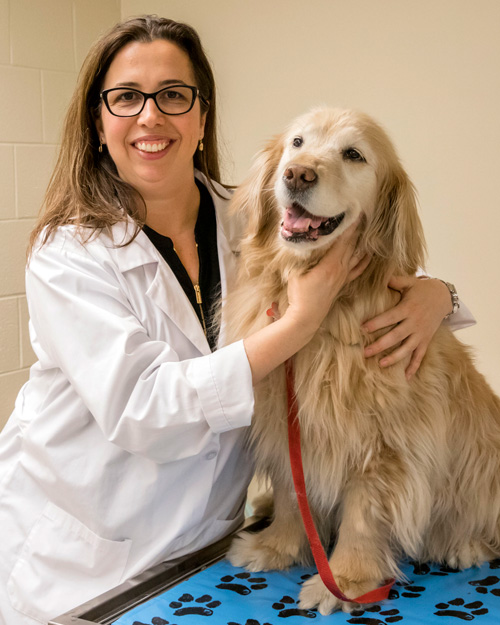
Unlike people, who often show their allergies through sneezing or watery eyes, allergic animals primarily have their skin affected and secondary bacterial infections aggravate the problem. And for owners, the signs are usually hard to miss.
“Most animals with skin infections are itchy,” Dr. Souza points out. “Sometimes they are already itchy because of allergies, and they get markedly itchier because of the pyoderma.” Owners may also notice visible changes. “If owners see some scaling, small pink lesions resembling mosquito bites, or yellowish crusts, they should bring their animal to the veterinarian.”
While many owners worry that certain breeds are more prone to pyoderma, Dr. Souza stresses that the bigger issue is allergy prevalence. “I personally don’t think there is one breed of dog that is more predisposed than others,” she notes. “All allergic dogs can have pyoderma.”
Diagnosing Pyoderma
One of the most important messages Dr. Souza hopes to convey to pet owners is that pyoderma must be properly diagnosed.
“Cytology is essential to confirm pyoderma,” she says. “Without cytology, we can suspect, but we will not have a definitive diagnosis.” For cytology, veterinarians collect samples from the skin and examine them under a microscope.
Sometimes veterinarians will culture the bacteria found on the pet’s skin to identify which antibiotics the bacteria respond to. “Culture is recommended when we suspect resistant infections,” Dr. Souza explains. Classic candidates for culture tests include pets that have had multiple antibiotic courses, infections that don’t resolve with treatment, or new pyoderma lesions that appear despite antibiotics administration.
Treating Pyoderma
Dr. Souza supervised a clinical trial at the University of Illinois evaluating how long dogs need antibiotics for superficial pyoderma, the most common form of the disease.
“The main goal of this study was to determine the ideal duration of antibiotic prescriptions,” she says. “At the end, we saw that two weeks of systemic antibiotic treatment should be enough for the great majority of superficial pyoderma cases. We may even be able to use it for a shorter period if topical antibacterial treatment is prescribed together.”
Additionally, and of importance, Dr. Souza notes: “That’s the idea nowadays: to try to use as little as possible of antibiotics so that we are not allowing bacteria to develop resistance.”
She also warns owners against using leftover antibiotics or stopping treatment early. “Failing to complete the full course of antibiotics or using antibiotics prescribed for something else could contribute to bacterial resistance,” she says.
Finally, rechecks are essential so veterinarians can re-assess the skin infection and determine whether it has resolved.
Treating Early, Addressing the Cause
The longer pyoderma goes untreated, the more uncomfortable pets become – and the more likely the infection is to spread, recur, or require aggressive treatment later. Early diagnosis and proper management of the underlying allergy, endocrine issue, or other skin disorders are essential to prevent these infection cycles from repeating.
For owners frustrated by their pet’s repeated pyoderma, Dr. Souza stresses the need to address the underlying problem, which is often allergies.
Most current research focuses on allergy control to get at the root of the problem. “We’ve been seeing companies developing more options for allergy treatment,” Dr. Souza says. “That’s been the focus. Not specifically pyoderma, but controlling the underlying disease.”
With advances in allergy care, dermatologists hope future patients will experience fewer bacterial infections overall.